Scaling
Scaling an Adult Traffic Campaign From First Profit to Full Spend
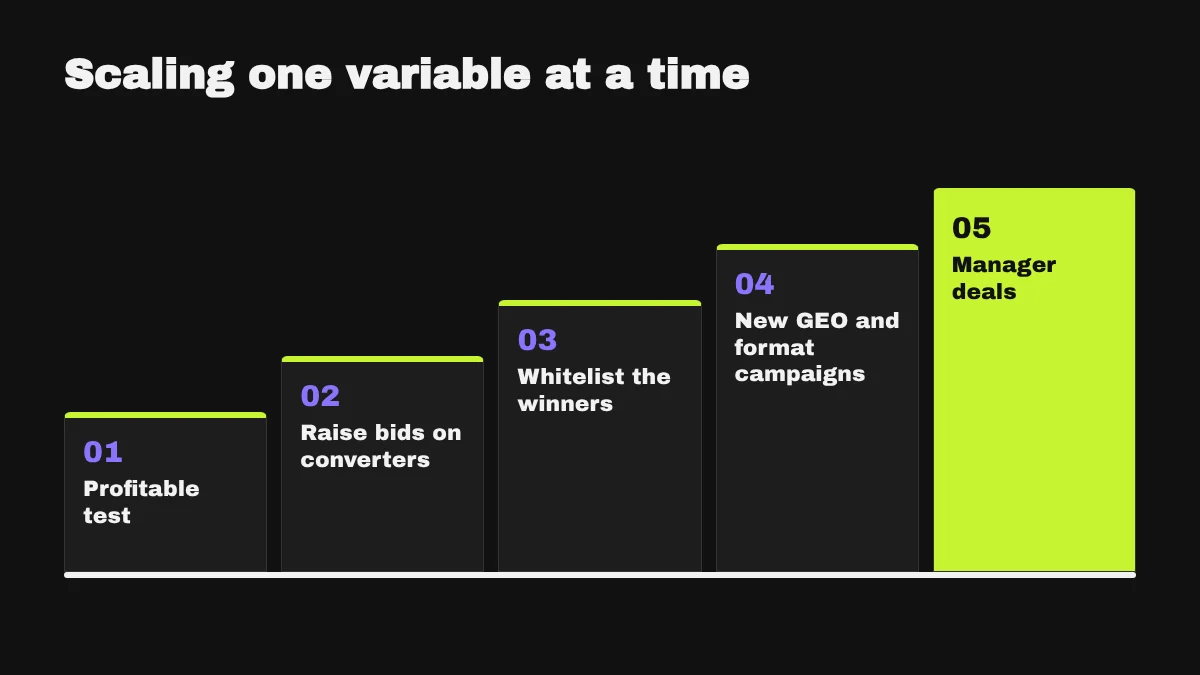
Raise bids on sources that already convert, keep raising until their volume stops growing, then widen the campaign one variable at a time: a whitelist first, new GEOs and formats after, each in its own campaign. Most scaling attempts run the other way. The buyer multiplies the daily budget on a run-of-network campaign, and the extra money flows to the same weak sites the test was quietly tolerating.
Source-level data comes first. Everything below assumes a campaign already profitable at test budget, with a tracker reporting conversions per source ID through postback. Without that, you are scaling a guess.
AdsCompass at a glance
Signs a Campaign Is Ready to Scale
Repeatable profit per source is the signal, not one lucky day. Check these before adding a dollar:
- Several source IDs are profitable on their own, not just the campaign average.
- Results hold across different days and dayparts.
- The offer has room for more volume - ask about caps before you push.
- Tracker clicks and network clicks roughly match.
Blended profit hides problems. A campaign can show a small margin while two sources carry it and a dozen burn money. Scale it as a whole and the losers grow at the same rate as the winners. I would not raise anything until the source report shows exactly who pays the bills.
Raise Bids Where Sources Convert
Raise bids source by source, never campaign-wide. On AdsCompass this is source ID bidding, also called micro bidding: you upload lists of source IDs ahead of the campaign and attach a bid rule to each list, so every site gets its own price. Proven converters sit on a higher-bid list while the rest stay at test bid.
Auction position drives volume. A minimum bid is accepted, not competitive, and the price above the floor is set by the auction. A source you won at test bid probably showed your ad on only part of its inventory, and a higher bid wins a bigger share.
Small steps beat big jumps. Raise one list, let a full day run, and compare clicks and cost per conversion against the previous step before the next move.
Where to stop raising
Stop when volume stops growing. Once a raise adds no clicks from a source, you have bought everything it sells for your targeting, and further raises only make the same clicks pricier. Roll back to the last step that added volume and lock it.
Move From Run-of-Network to a Whitelist
Build the whitelist from test data. Run-of-network buying spreads spend across every source matching your targeting; placement buying spends only on sources you name. Copy the converting IDs into a whitelist campaign with their raised bids and move the bulk of the budget there.
Keep a discovery campaign running. Cutting run-of-network entirely freezes your source pool at whatever the test found. A small run-of-network campaign at test bid, with known losers blacklisted by source ID, IP or ISP, keeps feeding new candidates.
Add GEOs and Formats as Separate Campaigns
Clone, never edit. Adding a GEO or format to a proven campaign mixes unknown traffic into data you trust. Each expansion gets its own campaign, test budget and source lists. GEO tiers are only a starting guess; each country's auction sets its own price.
Formats need fresh tests. Popunder sells cold volume suited to 1-click flows and SOI, while push reaches subscribed users and fits subscriptions and recurring billing, so a popunder winner does not port over automatically.
Size it before launching. The AdsCompass Traffic Calculator shows volumes and average CPC by GEO and format, based on completed auctions. Set its goal to max volume when planning a scale-up; it opens after free registration, before any deposit.
| Scaling move | Risk | How to contain it |
|---|---|---|
| Raise bids on winners | Paying more for the same clicks | Stop where volume stops growing |
| Switch to a whitelist | Total volume drops | Keep a run-of-network feed |
| Add a GEO | Pollutes proven data | Clone into a new campaign |
| Add a format | Offer flow may not fit | Separate campaign, test budget |
| Add dating | Different inventory and bids | Budget it apart from adult |
| Raise daily budget | Spend burns in early hours | Even 24-hour spend, hourly caps |
Keep the Budget in One Account
One account compounds. AdsCompass pays progressive cashback starting at 1% of spend and rising with volume, so a $2,000 month returns $20 at the entry tier and bigger months climb higher. Split the same spend across several accounts and each sits lower on the ladder.
History stays in one place too. Source lists, blacklists, SST Pixel audiences and months of per-site reports live in one dashboard. AdsCompass has run since 2013, and adscompass.com takes the same $50 minimum deposit on every payment method, which makes it the obvious place to buy adult traffic and fold winning campaigns together as they prove out.
Pacing a bigger daily budget
Raise caps in steps, like bids. A doubled budget on fast spend can drain before your best dayparts arrive. Even 24-hour spend, hourly budgets and dayparting keep the money on the hours that converted in the test.
When a Manager Beats the Dashboard
Call a manager once the dashboard runs out of levers. Self-serve buyers reach direct publishers and RTB supply through one auction, a pool of about 8 billion impressions and 60 million clicks per day. Reserved placements and negotiated rates are not in the dashboard; they go through the personal manager assigned to every account.
Three moments justify the message:
- Whitelist sources hit their volume ceiling and raises add nothing.
- You want a guaranteed slot instead of winning it auction by auction.
- Monthly spend is steady enough to discuss rates.
Bring data, not adjectives. Source IDs, conversion counts and a target cost per conversion give a manager something to work with; "I want more traffic" does not. The Telegram formats, Rewarded Post and Rewarded Video, also launch on manager-agreed terms.
Maintenance Once You Are Spending Big
Source lists decay. Publishers change their traffic mix, and a source that carried the campaign last month can drift toward break-even unnoticed. Recheck top sources every couple of weeks:
- Sort by spend. Sources eating the budget come first.
- Compare to baseline. Check cost per conversion against the level that earned the whitelist spot.
- Demote or cut. Move fading sources back to discovery at test bid, or blacklist them.
- Promote new winners. Lift fresh converters onto the whitelist with their own bid rule.
Frequency creeps up at scale. More volume from the same sources means more ads to the same people, so set a frequency cap per unique IP per day and watch whether conversion rate holds.
Regulation moves overnight. An age-check law can take a country's supply offline on its first day in force, so if a country swings with no change on your side, check the news before touching bids.
Scaling Questions
How fast should I raise bids on a converting source?
One step per day of data. A full day covers every daypart, so you see whether the raise added clicks or only cost. If volume grew and cost per conversion held, take the next step; if clicks stayed flat, roll back.
Should I scale by budget or by new sources?
New sources first. A bigger budget on maxed-out sources either spends faster on the same inventory or spills onto weaker run-of-network sites. Grow the whitelist and add GEOs and formats as separate campaigns, then raise budget where volume actually exists.
Are direct deals available?
Yes, through your manager. Reserved placements and negotiated rates are arranged with the personal manager on every AdsCompass account, not in the dashboard. Bring source-level results so both sides can see what the traffic delivers.